Why Cambridge, and what it does and does not promise
A plain account of the curriculum we teach, so you can compare schools on what matters.
What Cambridge is
Cambridge International Education is part of Cambridge University Press & Assessment, which sits within the University of Cambridge. It writes the curriculum frameworks, sets and marks the external tests and exams, and trains teachers. Schools in more than 160 countries use its programmes.
Cambridge decides what children learn at each stage. It does not set how a school teaches, how big classes are or how much homework is given. Those are the school’s decisions, which is why two Cambridge schools can feel completely different.
How Orchids delivers Cambridge
One sequence, age 3 to 16
Early Years, Primary, Lower Secondary and IGCSE are planned as one path, so each year builds on the last.
Teachers trained before they teach
Every teacher completes Cambridge training for their stage or subject. We hire for the ability to plan from learning objectives, not a chapter list, and test it with a live planning task at interview.
External checks at Grades 5 and 8
Cambridge Checkpoint gives an outside view against children worldwide. Grade 5 already runs at Bengaluru; Grade 8 follows by 2028-29.
Practical science from the start
Primary children do science in a science room. Secondary children work in proper laboratories.
Indian requirements met in full
We teach the state language, follow state recognition rules and register every child on UDISE+ and PEN.
Cambridge sets what. Orchids sets how.
The Orchids Teaching Way is the classroom approach used across the network.
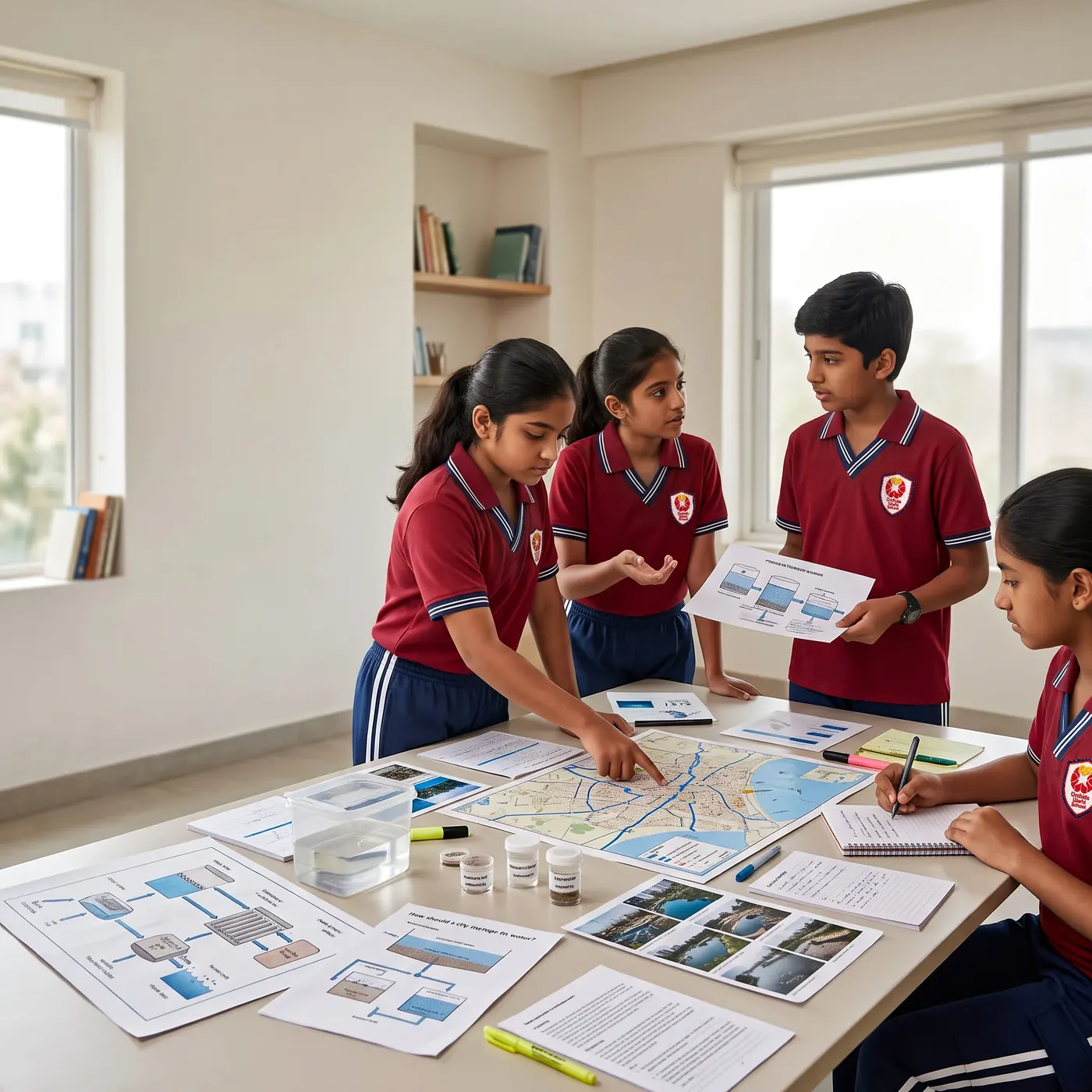
Global Perspectives
Students pick a real question, such as how a city should manage its water, and investigate it using evidence from different sources. They work in teams, weigh up views they disagree with and present a reasoned conclusion.
It runs from Primary upward and builds the research and writing habits every other subject uses later. It is also the part of a Cambridge education furthest from a textbook-and-chapter approach.
What a Cambridge qualification counts as
- Grade 5 (Stage 6); Grade 8 (Stage 9) by 2028-29
Cambridge Checkpoint
A diagnostic test. No certificate, no pass or fail.
- Grade 10
Cambridge IGCSE
Treated as Class 10 equivalent for a pass in five subjects, including English, with at least 33% in each. Results show Percentage Uniform Marks for admissions in India.
- Grades 11 and 12, planned from 2029-30
Cambridge AS and A Level
Class 12 equivalent, subject to conditions on the number and combination of subjects. Accepted directly by universities abroad.
- Grades 9 and 10
CBSE (optional)
Offered as an optional route for families who prefer it. Details are shared with Grade 8 families.
One thing parents are often not told
IGCSE alone does not make a student eligible for Indian undergraduate admission. That needs a Class 12 equivalent. Equivalence rules are changing. In 2025 responsibility for Indian boards’ certificates moved to NCERT (PARAKH), and how Cambridge qualifications are treated is still being updated. We confirm the current position with every family at admission and brief every Grade 8 family before IGCSE choices are made.
How is Cambridge different from CBSE?
Cambridge sets learning goals for each stage and tests them against international benchmarks. It leaves textbooks, timetable and teaching method to the school. CBSE sets a detailed national syllabus. Here the Cambridge goals are taught through the Orchids Teaching Way, with practical work and projects.
Is it less stressful than CBSE?
It can be. Cambridge covers fewer topics in more depth and expects more writing, discussion and practical work. How stressful any school feels depends on how it teaches, so ask to see a lesson when you visit.